
Rosa Parks
February 4, 2026
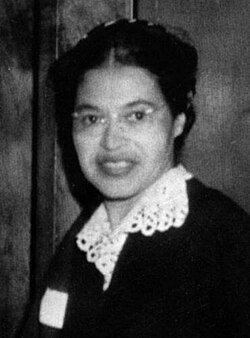 Rosa Louise McCauley Parks (February 4, 1913 – October 24, 2005) was an American civil rights activist. She is best known for her refusal to move from her seat on a bus in Montgomery, Alabama, in defiance of Jim Crow racial segregation laws, in 1955, which sparked the Montgomery bus boycott. She is sometimes known as the "mother of the civil rights movement".
Rosa Parks was a civil rights activist whose refusal to give up her seat on a segregated bus in 1955 helped launch the Montgomery Bus Boycott. Considered the "mother of the civil rights movement," her act of defiance and lifetime of activism inspired lasting change toward racial equality.
Early life and activism:
- Born into a segregated world: Born Rosa Louise McCauley on February 4, 1913, in Tuskegee, Alabama, Parks was raised by her grandparents in a world of racial discrimination and Jim Crow laws.
- Early civil rights involvement: Long before her famous bus protest, Parks was an active member of the NAACP. She joined the Montgomery chapter in 1943, where she worked as its secretary for over a decade and focused on issues like criminal justice and voter registration.
The Montgomery Bus Boycott:
- Refusal to move: On December 1, 1955, Parks was taking the bus home from her job as a seamstress. When the "white" section of the bus was full, the driver ordered Parks to give up her seat in the "colored" section to a white passenger. Parks refused, later stating that she was "tired of giving in".
- Arrest and protest: Parks was arrested and fined. Her action spurred the Women's Political Council, an organization of Black women, to call for a boycott of the Montgomery bus system.
- Sustained protest: The Montgomery Bus Boycott began on December 5, 1955, and lasted for 381 days. The protest brought a young minister, Dr. Martin Luther King Jr., to national prominence as its leader.
- Supreme Court victory: In November 1956, the U.S. Supreme Court upheld a lower court's decision that declared bus segregation unconstitutional. The boycott ended the next month when the city of Montgomery was ordered to desegregate its buses.
Post-boycott activism and legacy:
- Continued hardship and relocation: Following the boycott, Parks lost her job and received death threats. In 1957, she and her husband moved to Detroit to escape the harassment.
- Lifelong fight for justice: In Detroit, Parks continued her activism, fighting against housing segregation and police brutality. From 1965 to 1988, she worked as a secretary for U.S. Representative John Conyers.
- Later work and legacy: Parks co-founded the Rosa and Raymond Parks Institute for Self-Development in 1987 to educate young people about civil rights. After her death in 2005, she became the first woman to lie in honor in the U.S. Capitol Rotunda.
- Awards and recognition: For her contributions, Parks was awarded the Presidential Medal of Freedom in 1996 and the Congressional Gold Medal in 1999.